Home / Pricing
Most roofers won’t give you a number until they’re standing in your driveway. Ours are below. You’ll find the figure on your estimate is the one on this page — we quote everybody the same way.
A square is 100 square feet of roof — it’s how roofing is measured everywhere, and it’s roughly the size of a small bedroom floor. A typical house around here is 20 to 25 squares.
A 22‑square roof is about $19,250. Twenty squares is $17,500; twenty‑five is $21,875.
Cash, cheque, bank transfer or card — same number. We don’t add a card fee at signing.
That same 22‑square roof is $22,000 on a monthly payment plan. Twenty squares is $20,000; twenty‑five is $25,000.
The gap is what it costs us to be paid over years instead of on the day.
Those are the only two numbers. There is no membership rate, no “today only” rate, no cash discount, and no rate for people who sound like they can afford it. One price, whoever you are and however you pay it.
Minimum roofing job $5,950, about seven squares. Smaller work is priced from the repair book further down this page.
Want the reasoning rather than the number? Our cost guide explains what moves a roof’s price →
We’d rather tell you that here than have you work it out from three quotes. Here’s what the cheap one actually buys you.
Somebody has to absorb the difference. It comes out of the crew, the material, or the time spent getting it right.
Fewer nails. Re‑used flashing. Skipped hand‑sealing in the cold. The things nobody sees from the driveway.
And it looks finished either way. That is the whole problem with buying a roof on price — you cannot see what you got.
Or the first windstorm, or four winters later. And by then it is yours.
A roof is the most important thing on the whole house. You have an issue with the roof, you have an issue with the house — and an issue with the roof is never cheap. Spending more up front is what buys you the long term.
We’re not pitching you on expensive. We’re telling you where the money goes, and we put the number in writing so you can judge it for yourself.
And only three. If anything else turns up on your estimate, ask why.
If there’s an old roof under the current one, it has to come off too — twice the tear‑off, twice the disposal. +$45 a square.
We count it from the tear‑off photographs, so you can see what you paid for. It costs us more than we charge for it.
Steeper and higher is slower and more dangerous, so it costs more — and only on the parts of your roof that are actually steep or high, never the whole thing.
Steep, 8/12 to 10/12 — +$20 a square
Steep, 11/12 and up — +$45 a square
Second storey, or an eave over 16 ft — +$20 a square
Third storey, or anywhere we need staging — +$35 a square
A walkable one‑storey roof is none of these.
Rotten plywood underneath has to be replaced, and nobody can know this from the ground — including us. We find it at tear‑off.
The first three sheets are included. Anything extra is $95 a sheet, and we photograph before and after, so you can see exactly what you paid for.
Not at signing. Not before anything arrives. You pay for material on the day it’s delivered to your house, and the balance when the roof is finished and you’ve walked it with us.
New York law bars roofing deposits. Most people don’t know that, and plenty of contractors still ask.
If you put a third down with somebody else, the question is whether you ever see that money again.
Nothing we’ve been paid is money you can’t see the result of. That’s the whole point of billing it this way.
If a roofer asks you for money before anything shows up at your house, that’s your answer.
Roofing is not a well‑regulated trade in New York. Nobody licenses it. So this is worth asking every contractor you talk to, not just us.
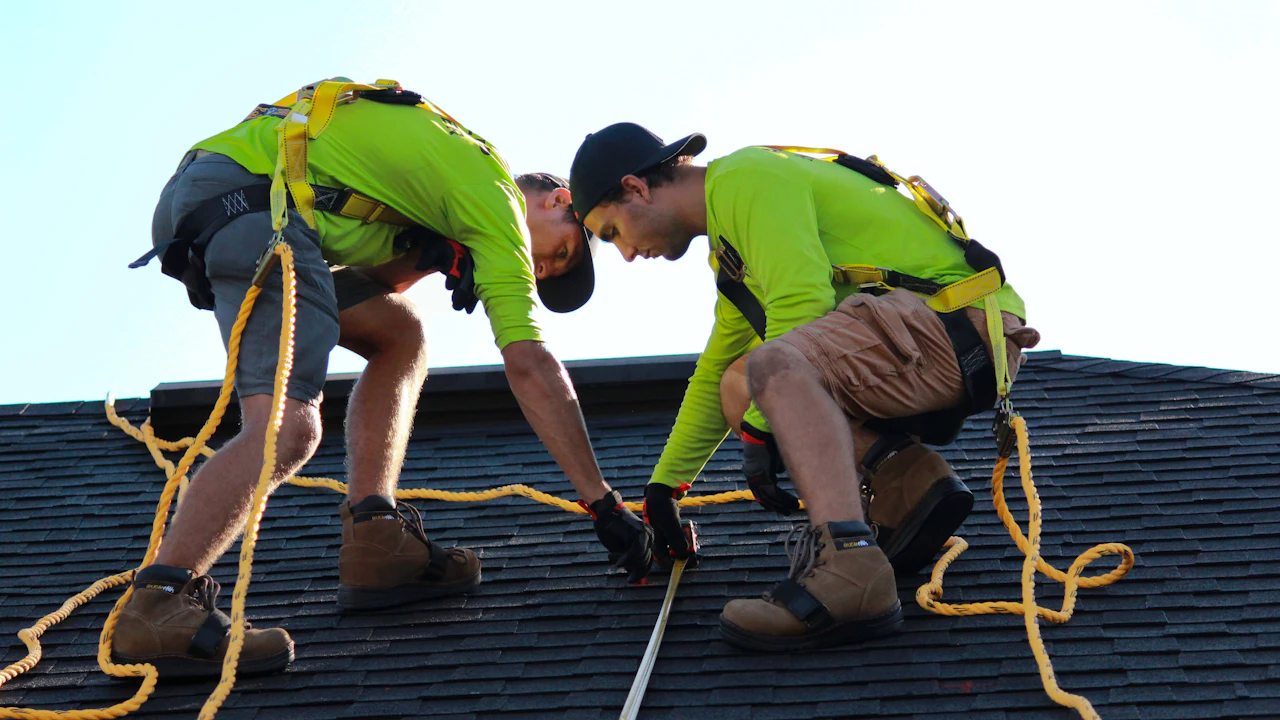
Anybody working on your roof follows OSHA standards — and that means tied off on every roof, not only the steep ones.
A small thing that tells you a lot. It’s the rule, it’s how people get hurt when it’s ignored, and you can check it from your own driveway.
That’s the standard we hold the day to. It costs time and it costs money, and it’s not negotiable.
And ask everybody else for theirs. A contractor who can’t produce one on request is telling you something.
This is where a cheap quote and an honest one stop being the same job. All of the following is included — not added at the end.
Down to the deck, and every bit of the old roof hauled away.
Three feet inside the warm wall — a foot past what code asks for — and in every valley.
Over the whole roof, not just the bottom courses.
Both edges, both courses. The rake is where a cheap roof is cheapest.
New, not re‑used — which is where most leaks start.
Every penetration re‑flashed, not caulked.
Exhaust at the peak, balanced against the intake at the soffit.
Not 3‑tab. Longer life and a stronger wind rating, which matters here.
Where your town requires one. Part of the price, not an extra.
What we found and what we did, slope by slope, yours to keep.
More than once, and again before we leave.
On top of the manufacturer’s shingle warranty. Transferable once.
Every roof we put on meets the New York residential code. Where your town requires a permit we pull it, and where the town inspects, they inspect.
But here is something most people don’t know: plenty of towns around here don’t require a permit for a re‑roof at all, and where there’s no permit there’s no inspection. Nobody official is coming to look. Which is exactly why we photograph everything — so you have the record either way, and so does whoever buys the house from you.
Code requires the ice barrier to reach 24 inches inside the warm wall. We run 36. On most roofs that’s a second course of membrane rather than one.
Ice damming is how roofs fail around here. It isn’t wind and it isn’t age — it’s water backing up under shingles in February. The extra foot is the cheapest insurance on the whole roof.
Drip edge at the eaves and the rakes — code requires both — and starter course at the rakes too, not just the eaves.
The rake is where a cheap roof is cheapest, because once the shingles are on nobody can see what’s underneath them. Skip the drip edge and water wicks back and rots the fascia from behind. Skip the starter and the edge shingle has nothing bonding it down — which is where wind gets under a roof and starts peeling it.
Intake at the soffit and exhaust at the ridge, in proportion. Required by code, and almost never checked by anyone.
Bad ventilation shortens a roof’s life more than weather does. It cooks the shingles from underneath in summer and feeds ice dams in winter. If your attic is the problem, we’ll tell you that before we quote a roof.
Where a permit is required we pull it ourselves and it’s part of the price, not an extra. If a roofer suggests skipping one that is required, understand what that means: no independent check on any of the above, and something to explain on the disclosure when you sell.
Generally, if there’s a problem with a roof, it’s found on the first rain. But the fifteen years isn’t really about that. It’s so you know the money you spent was well invested.
If anything comes up — for you, or for whoever buys the house after you — we come take a look and get it taken care of.
Put a roof on with us and that roof is no longer your liability for fifteen years.
The manufacturer warrants the shingle. The roofer warrants the work — and almost every leak is workmanship, not product. Ours transfers once, to the next owner.
Repairs are not warranted, and we say so rather than letting you assume otherwise.
Repairs are priced from a flat‑rate book, so the number doesn’t depend on how long it takes us.
From $299 on a walkable roof. More on a steep or very steep one, because it’s slower and takes more gear.
Waived when the visit turns into a roof.
Pipe boot — $700 · shingles, up to ten — $185 · ridge vent — $215 per 4 ft · chimney flashing and counter‑flashing — $1,265 · skylight reflash — $750 · emergency tarp from $450.
The full book is on the estimate.
Scheduled work has a $900 minimum so a van and a morning aren’t spent on fifteen feet of gutter.
Waived when it’s sold with a roof.
If it’s leaking, we can usually stop it the same day. If the fix needs material that has to match your roof, we’ll order it and give you a date.
An emergency tarp, a pipe boot, a vent collar, flashing against a wall or a chimney apron, drip edge, sealant work, a gutter reseal or re‑hang, shingles lifted and re‑set.
These are parts that don’t have to match anything — they sit under the shingles or they’re a colour we carry.
A ridge vent, a valley, a downspout, a rafter tail.
A ridge vent needs cap shingles laid over it, so this one depends on whether we’re carrying your colour.
More than about ten shingles, ridge cap, a skylight kit, chimney flashing on an irregular chimney, soffit, fascia and gutters.
Usually within a week. We measure it on the first visit so the second one is just the work.
One thing worth knowing before anybody gets on your roof: a patch on a weathered roof will be close, but it will not be invisible. Shingles fade in the sun, so even the correct current product won’t match a twelve‑year‑old roof exactly. Anyone who tells you otherwise hasn’t done it. We’ll show you what to expect before we start, not after.
No sales presentation, and nothing to sign on the day unless you want to.
All of them, not a walk round the outside with a clipboard.
Most roofers never go up there. It’s where deck rot, bad ventilation and the real leak path actually show themselves.
Pipe boots, vents, the chimney, the skylight. Penetrations are where roofs leak.
We show you everything we found and tell you what needs to happen — with the number, in writing, before we leave.
And if it’s a repair, we’ll tell you it’s a repair. We’d rather do an honest $700 job and be the people you call in nine years than sell you a roof you didn’t need today.
We’ll inspect your roof, photograph it and give you the documentation. You file and your insurer decides. We don’t adjust claims, we don’t rebate deductibles — New York GBL §771‑b makes that insurance fraud — and nobody honest can promise you a free roof.
Metal roofs, flat or torch‑down roofs, and commercial buildings. Not our trade.
Both need a licensed abatement contractor, and we’ll tell you so rather than guess.
Other than the repairs priced from the book above.
There’s one card and it’s this one. Published is the whole point.
Multiply your squares by $875, or by $1,000 if you’re financing. Most houses here are 20 to 25 squares — so roughly $17,500 to $21,875, or $20,000 to $25,000 financed. A second layer, a steep pitch or an upper storey, or rotten decking moves it. Nothing else does.
Because being paid over years costs us something and being paid on the day doesn’t. We’d rather show you both numbers than publish one and call the other a discount. There is no list price here — there are two prices.
No. We’re a new company and we don’t have members. Everybody gets the two prices on this page.
Only for the three things on this page, and only with photographs. Rotten decking is the usual one — nobody can see it from the ground, so we find it at tear‑off, photograph it, and show you before we replace a sheet. The per‑sheet price is on your estimate before we start.
No. New York law bars roofing deposits and we wouldn’t take one anyway. You pay for material the day it’s delivered and the balance when the roof is finished and you’ve walked it with us.
We might not be — our number is on this page, so you can check rather than wonder. But we’re not trying to be the cheapest. If you shortchange the contractor you shortchange the project, and on a roof you find that out on the first heavy rain. We’d rather show you where the money goes.
No. New York law bars roofing deposits and we don’t take one anyway. You’re billed for material the day it’s delivered to your house, and the balance when the roof is done and you’ve walked it with us.
From $299 on a walkable roof — more on a steep or very steep one, because it’s slower and needs more gear. If the visit turns into a roof replacement, the visit fee comes off.
We’ll get on the roof, photograph every slope, check the attic and every penetration, and give you a written number before we leave. If it’s a repair, we’ll tell you it’s a repair.
We photograph every slope, price every line, and hand you the answer before we leave — no pressure, no driveway renegotiation.
